
Checking Refugio County Criminal History
Begin with the event or status you need to confirm, not with a broad name query. Refugio County felony files belong with the District Clerk. Class A and B misdemeanor files run through the County Clerk, while a fine-only matter may remain with a municipal court or justice court. Current local custody is a separate question for the Refugio County Jail. A sheriff report is separate again. The Texas DPS Criminal History Conviction Name Search adds public Texas convictions and deferred adjudications reported to DPS, but it does not replace a Refugio County clerk file.
Gather the full legal name, spelling variants, date of birth when lawfully available, an approximate year, and any case, incident, booking, or citation number. These details reduce false matches and help Refugio County staff retrieve an older file. Then use the route that fits the record:
- Identify whether the event was an arrest, a filed court case, present custody, a warrant, or a statewide history entry.
- Call the District Clerk for a felony or the County Clerk for a county misdemeanor and ask about the posted docket and case register.
- Call the jail or use VINELink for custody, then request the booking record from the sheriff when a status screen is not enough.
- Search DPS for the statewide public conviction slice, using all available name refiners and checking likely candidates with care.
- Obtain a plain or certified source record from the Refugio County custodian when the exact disposition or filing must be proved.
The official DPS interface can be seen in the DPS conviction search source.
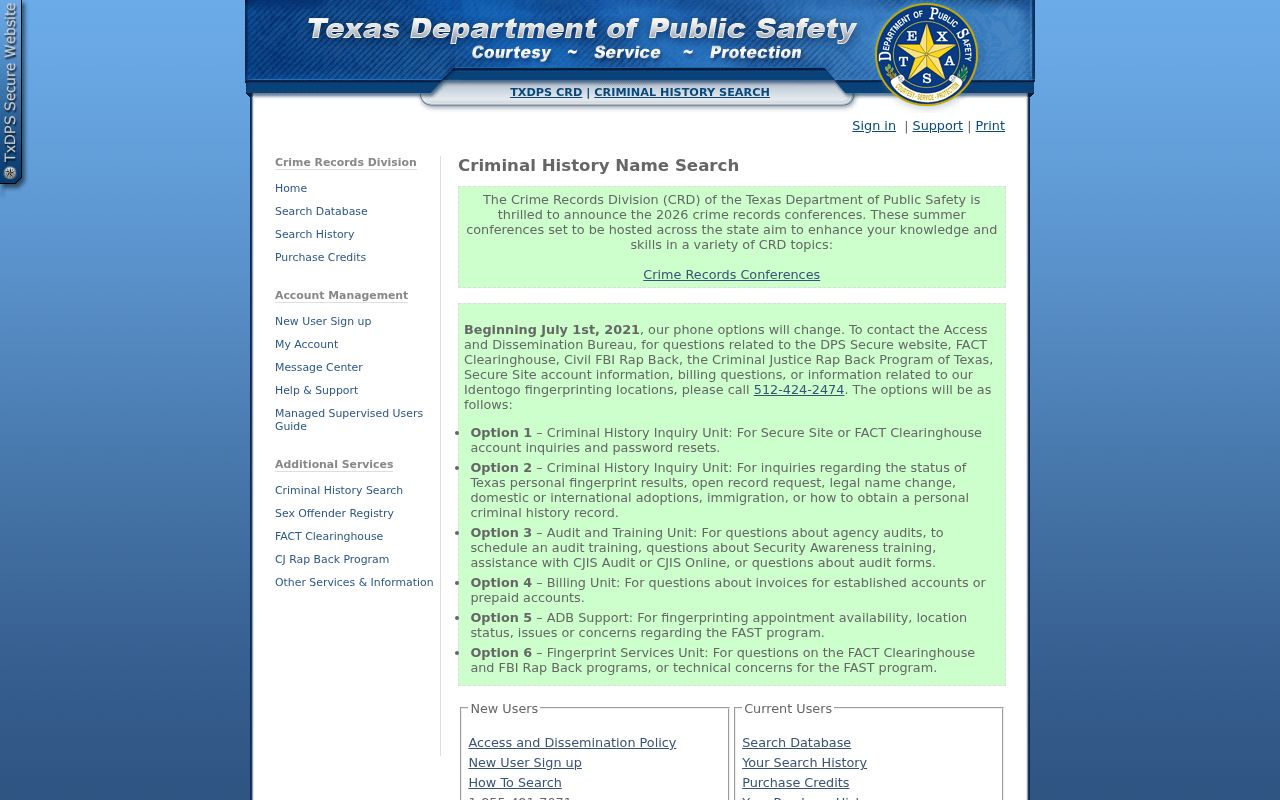
Its account and credit workflow shows why a DPS query is a distinct state product rather than a free Refugio County court docket.
No One-Stop Refugio Criminal Search
Refugio County records are split by both record type and court level. The arresting agency creates the offense report. The jail logs intake and release. A prosecutor decides what accusation to file. The District Clerk keeps felony matters heard by the 24th, 135th, and 267th District Courts, while the County Clerk keeps County Court criminal matters. DPS later assembles reportable events submitted under Texas law. TDCJ separately controls prison and parole information.
This division explains common gaps. An arrest label can differ from the charge filed after review. A clerk docket may show a setting without displaying every motion or exhibit. A DPS result can omit a local event that was outside the public product, delayed, restricted, or not matched to the searched name. No result from one channel is not a clean bill from all channels.
Use this record flow when choosing an office: Arresting agency → Refugio County Jail → prosecutor → District or County Court → Texas DPS. For prison or parole, continue to TDCJ. For a federal prosecution, use PACER and the federal custody system instead.
Texas Official Background Checks
The Texas Department of Public Safety Crime Records Division maintains the central Texas repository. Its public name search reports qualifying convictions and deferred adjudications submitted to DPS. A name match is useful for leads, but DPS warns that similar names can attach the wrong result and spelling differences can miss a result. The public portal requires an account and search credits. Its live purchase screen controls the current price, so Refugio County users should not rely on an old fee quoted elsewhere.
For review of your own Texas record, DPS identifies fingerprint matching as the more accurate route. Texas Fingerprint Applicant Services of Texas uses IdentoGO by IDEMIA. Search the live scheduler with ZIP code 78377 because no stable official source confirmed a permanent Refugio County enrollment site. The FBI Identity History Summary is another fingerprint-based self-review product, but it answers a federal identity-history question rather than a Refugio County clerk or sheriff question.
| Official route | Method | What it answers |
|---|---|---|
| DPS public search | Name and refiners | Reported public Texas convictions and deferred adjudications |
| DPS personal review | FAST fingerprints | The subject's Texas criminal-history record |
| FBI summary | Fingerprints | The subject's FBI-maintained identity-history response |
| Refugio clerks | Name, year, or case number | Filed local cases, docket events, judgments, and copies |
The DPS Crime Records hub supplies the official program context shown here.
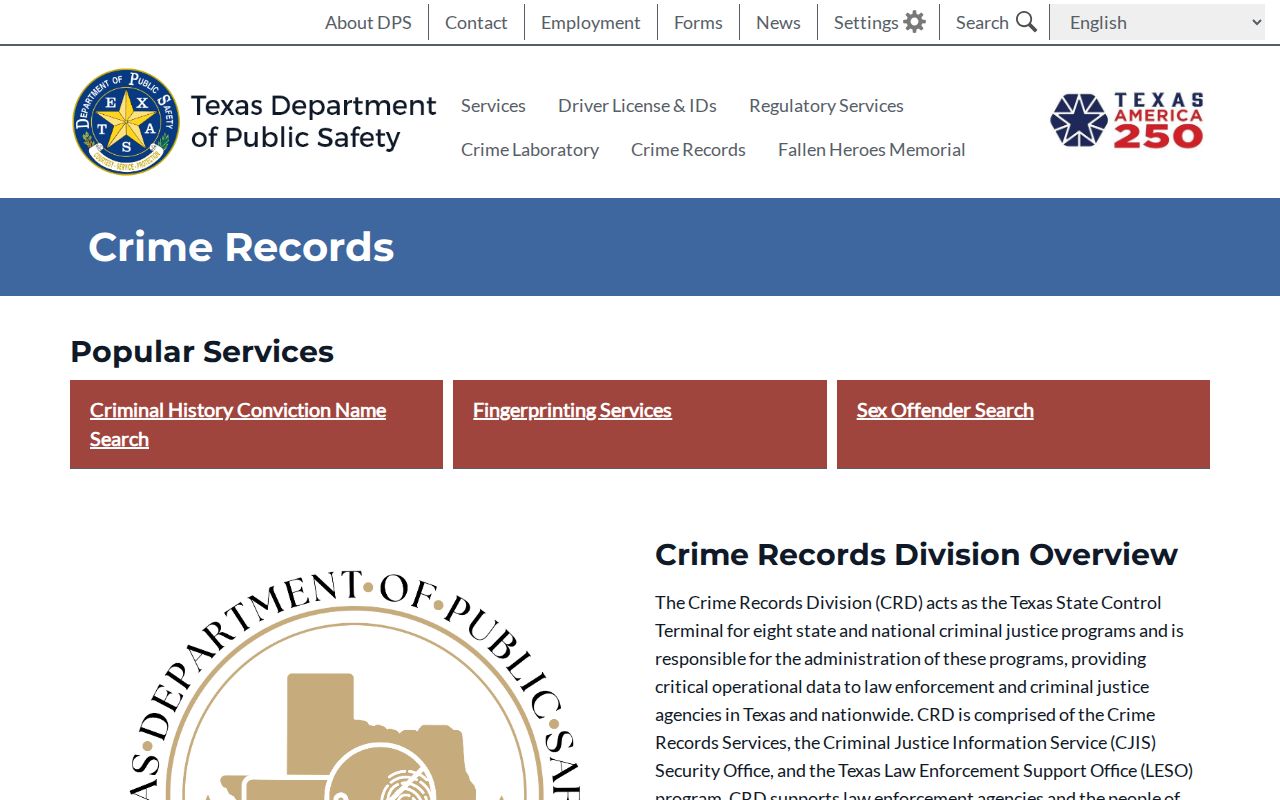
That hub separates public name checks, personal reviews, reporting, and correction procedures that serve different needs.
Refugio Courthouse Records Hub
The Refugio County Courthouse at 808 Commerce Street, Refugio, TX 78377 is a working records hub. The District Clerk, County Clerk, district-court settings, County Court, and Justice of the Peace Precinct 1 are concentrated there. That helps with a search that crosses court levels, but it does not merge the files. Call the District Clerk at 361-526-2721 for a felony-level file and the County Clerk at 361-526-2233 or 361-526-2727 for a County Court matter.
The County Clerk publishes dockets and detailed counter times. Public service runs Monday through Thursday from 8:00 a.m. to noon and 1:00 to 4:30 p.m.; Friday service ends at 4:00 p.m. after the afternoon reopening. Record-room and bound-book copy cutoffs differ. Ask whether a criminal file can be viewed at the same counter and whether older material needs advance retrieval. The District Clerk posts docket links but no separate lobby schedule. Its standing order on phones and recording devices should be read before bringing scanning gear into a court area.
The official Refugio County government entry point shows the department path used to reach these custodians.
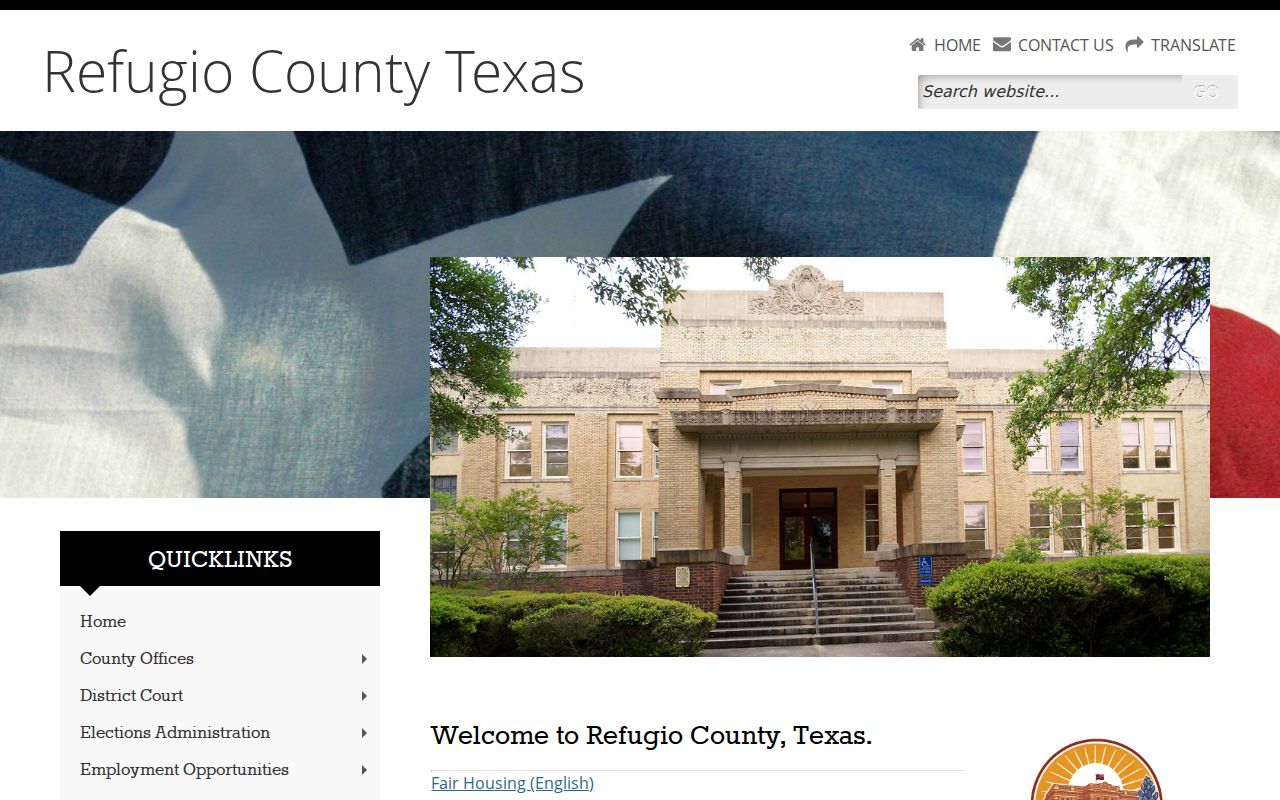
The department layout reinforces the local split between sheriff, district, county, and justice-court records.
Criminal Record Types
Each Refugio County record captures a different stage. An arrest and booking sheet records an allegation and custody event, not guilt. A complaint, information, or indictment is the formal accusation. The clerk's case file follows hearings, motions, pleas, judgment, sentence, bond, and costs. DPS criminal history arranges reportable arrest cycles and dispositions received from agencies. A custody record shows where a person is held, while a registry record serves a separate public-safety law.
- Law-enforcement record: an incident narrative, call material, arrest sheet, booking entry, or associated media held by the creating agency.
- Court record: the filed accusation, docket, orders, judgment, sentence, and costs held by the proper Refugio County clerk.
- State history: DPS data compiled from reportable agency and court submissions across Texas.
- Custody record: local jail status, TDCJ prison information, or federal custody data at the correct government level.
- Restricted record: juvenile, confidential, expunged, or nondisclosed material governed by its own access rule.
A focused request works best. Ask the sheriff for an existing report or booking document, not a legal conclusion. Ask a clerk for a case number, docket, judgment, or certified disposition. That wording sends the Refugio County request to the source most able to answer it.
Refugio Sheriff Uses VINELink
The Refugio County Sheriff's Office does not publish a native online jail roster or booking blotter. Its official page links VINELink for custody status and notifications. Start with the Refugio County Jail at 361-526-1698 when the question is immediate custody, release, or bond routing. Use VINELink as the notification layer. If more detail is needed, request the booking sheet or jail register entry from the sheriff under the Texas Public Information Act.
VINELink is not the arrest narrative, full booking packet, or court outcome. A no-match response can follow release, transfer, spelling differences, or a participation limit. The arresting city police department may hold the offense report even when the county jail handled intake. Then the right clerk holds the filed charge and disposition. The full Refugio County arrest lookup process traces those channels without treating custody as proof of guilt.
The official sheriff page is the source for the jail, dispatch, and VINELink routes.
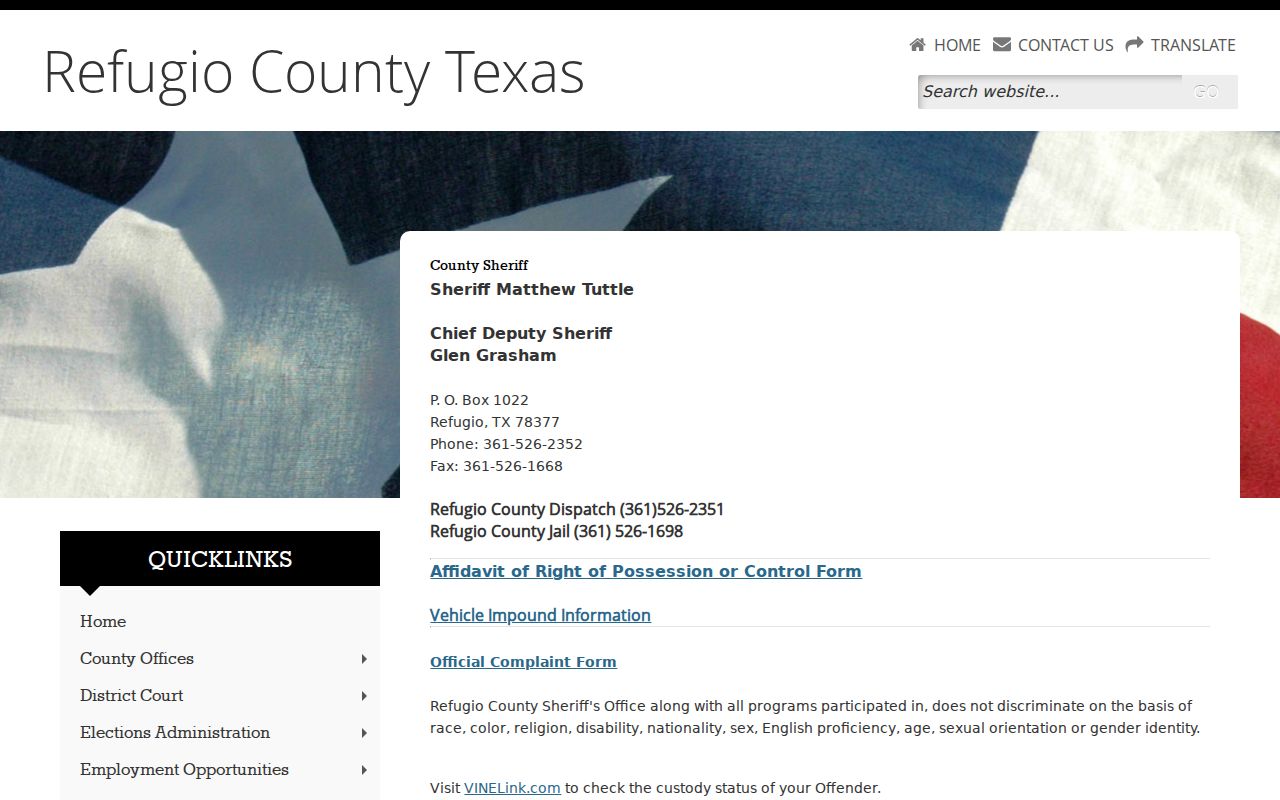
Its contact-led design is why callers should use the jail line first instead of searching an unofficial booking site.
Note: Refugio County has no verified sheriff mobile app, so similarly named third-party apps should not be treated as official sources.
Inside a Refugio County Criminal Record
A Texas criminal-history entry commonly begins with reported names, aliases, date of birth, sex, race, SID, and fingerprint-linked identifiers. It then groups arrest cycles, charges, prosecutor or court tracking, disposition, and sentence. A Refugio County court file is organized around its case number, filing date, court, parties, charging paper, event register, motions, orders, plea, judgment, and costs. The jail record instead centers on intake, stated charge, bond, release, and custody.
| Name and identifiers | Reported legal names, aliases, birth data, SID, and other matching details appropriate to the record. |
|---|---|
| Arrest and booking | Arrest date, creating agency, incident or intake number, stated charge, bond, and release status when public. |
| Filed charge | Complaint, information, or indictment plus the statute and charge level accepted by the court. |
| Case events | Settings, counsel, motions, orders, pleas, and other entries in the clerk's register. |
| Disposition | Dismissal, acquittal, conviction, deferred adjudication, no-bill, or another recorded result. |
| Sentence or supervision | Jail or prison term, fine, community supervision, parole data, and related dates where applicable. |
Protected personal data, victim or minor identifiers, medical details, and confidential exhibits may be withheld. A public record can be accurate within its scope yet still fail to answer the next stage of the case.
Refugio DPS Name Search Fields
The DPS public conviction portal requires sign-up, login, and search credits before a full Refugio County name search. It retains searches in Search History for seven days, while the portal notice says batch downloads remain in Message Center for 30 days. Use the legal surname and first name, then add refiners when the interface offers them. Similar names still require source-record checks.
| Field | Use | Key limit |
|---|---|---|
| Last and first name | Main name route | Spelling and name similarity affect matches |
| Middle name | Helps narrow common names | May be optional or absent in source data |
| Date of birth | Identity refiner | The search remains name-based |
| Sex and race | Additional refiners | Use only as the live workflow allows |
| Search credits | Required account balance | Verify the current price after login |
The DPS criminal-history FAQ explains the product's limits and matching concerns.
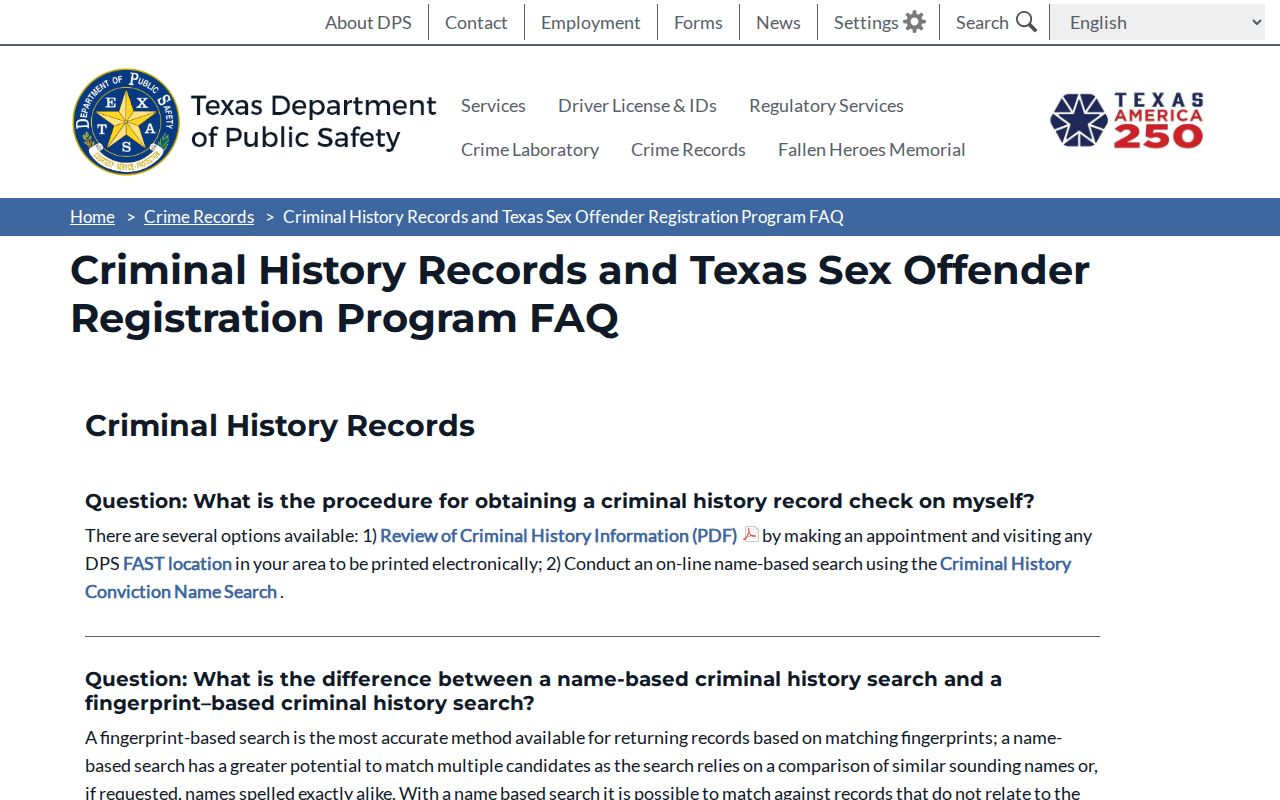
Those limits make a clerk judgment or fingerprint self-review the better confirmation when identity or final outcome matters.
Public Access Laws in Texas
The Texas Public Information Act governs requests for existing Refugio County government records, subject to exceptions and other confidentiality laws. The often cited ten-business-day period mainly concerns when an agency seeks an Attorney General decision to withhold information. It is not a promise that each report will be delivered in ten days. Active investigations, protected victim information, juvenile material, driver's-license data, medical facts, and other confidential fields may be withheld or redacted.
Criminal-history dissemination has its own rules. DPS may release qualifying conviction and deferred-adjudication information under Government Code Chapter 411, while Chapter 66 sets reporting duties. The public sex-offender registry runs under Chapter 62. The proper custodian still matters because a law granting access does not turn every record into one statewide database.
Key Texas laws:
Government Code Chapter 552 sets the public-information request process and exceptions.
Government Code Chapter 411 controls criminal-history dissemination and nondisclosure.
Code of Criminal Procedure Chapter 66 governs criminal-history reporting to DPS.
Code of Criminal Procedure Chapter 55 governs expunction.
Code of Criminal Procedure Chapter 62 sets sex-offender registration and public-access rules.
Request Refugio Sheriff Records
No separately named records division, online request portal, report-copy fee schedule, or local clearance-letter service appears on the Refugio County sheriff page. Address a focused request to the Refugio County Sheriff's Office, P.O. Box 1022, Refugio, TX 78377. The main line is 361-526-2352, dispatch is 361-526-2351, and fax is 361-526-1668. Call first to confirm the designated submission method and the right counter.
Describe an existing record. Give the incident or booking number if known, approximate date and time, location, arresting agency, requested document, and a narrow date range. State whether inspection or an electronic copy is preferred. Ask for an itemized estimate if cost may exceed your chosen limit. Refugio County did not publish a current sheriff copy fee or fixed turnaround in the official sources reviewed.
Refugio County Sheriff
P.O. Box 1022
Refugio, TX 78377
361-526-2352
Fax: 361-526-1668
District Clerk
P.O. Box 736
Refugio, TX 78377
361-526-2721
Felony and district files
County Clerk
P.O. Box 704
Refugio, TX 78377
361-526-2233
County Court files
The official elected-officials page confirms the current sheriff and clerks responsible for these Refugio County channels.
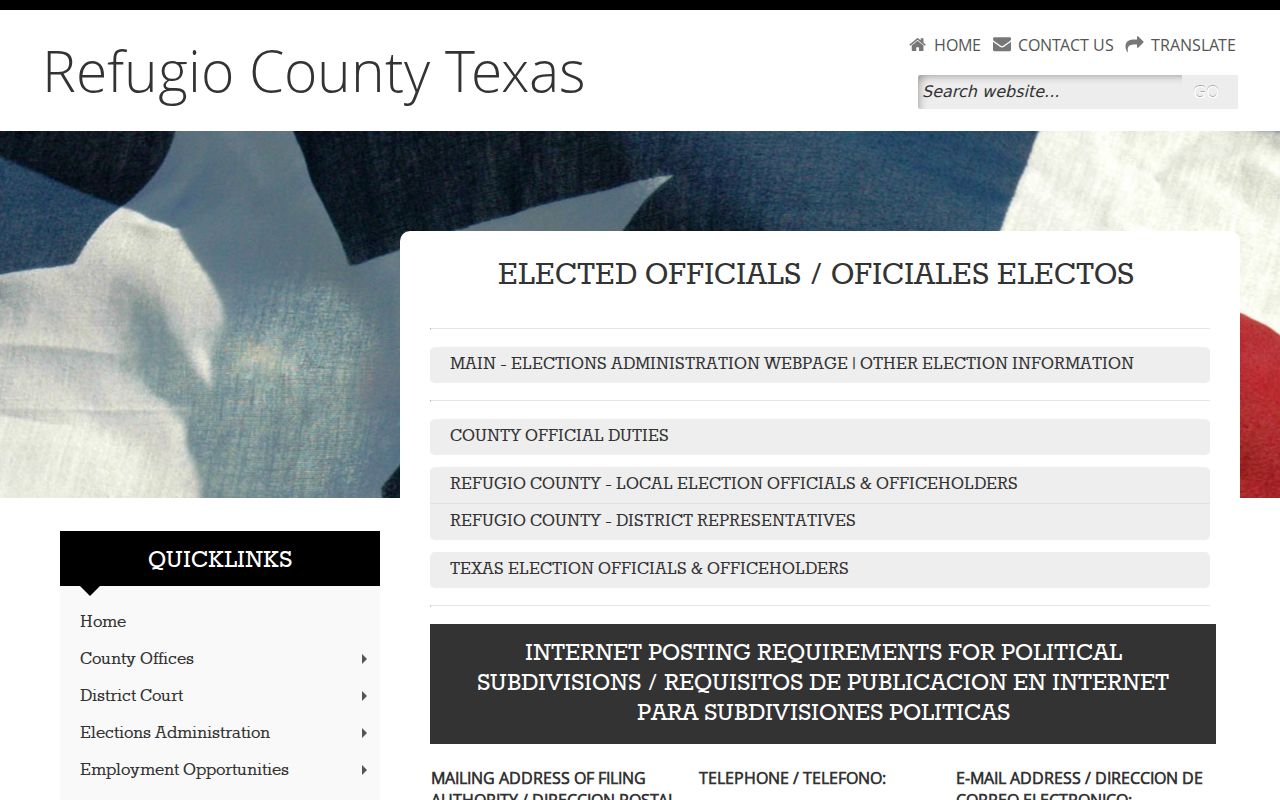
Current officeholder information helps avoid routing a request through an old name found in archived material.
Sealed, Expunged, and Restricted Records
Texas treats expunction and nondisclosure as different remedies. Expunction under Chapter 55 is the stronger remedy and applies only to stated situations such as certain acquittals, pardons, qualifying dismissals or no-charge outcomes, identity theft, and named programs. An order of nondisclosure under Government Code Chapter 411 can restrict ordinary public release of a qualifying deferred adjudication or enumerated conviction while preserving access for authorized entities.
Start with the complete Refugio County disposition and arrest identifiers. Compare each charge with current law, identify all agencies that hold the event, and use the current form route accepted by the court. The Refugio County District Clerk page provides an expunction resource. It does not publish a current filing fee or guaranteed timeline, so call 361-526-2721 before filing. After an order is signed, obtain certified copies and allow each custodian time to implement it.
- Expunction
- A court remedy directing covered custodians to destroy, delete, or return eligible records as the order requires.
- Nondisclosure
- An order limiting general public disclosure while leaving access for entities named in Texas law.
- Dismissal
- An end to a charge without conviction that does not, by itself, erase arrest and booking records.
- Deferred adjudication
- Community supervision without an immediate guilt finding; it is not the same as expunction.
Juvenile records follow separate rules. Even an otherwise public file may redact victim, minor, medical, Social Security, driver's-license, or other protected information.
Refugio Name Check or Fingerprints
A name search is convenient, but its match depends on words and biographical refiners. Fingerprints tie a self-review to the subject's prints and are more accurate for sorting out a similar name or a disputed identity. For your own Texas record, follow DPS personal-review instructions and schedule through FAST. The official scheduling line is 1-888-467-2080, from 8 a.m. to 9 p.m. Central.
The FAST and IdentoGO scheduler is the live source for locations and appointment times.
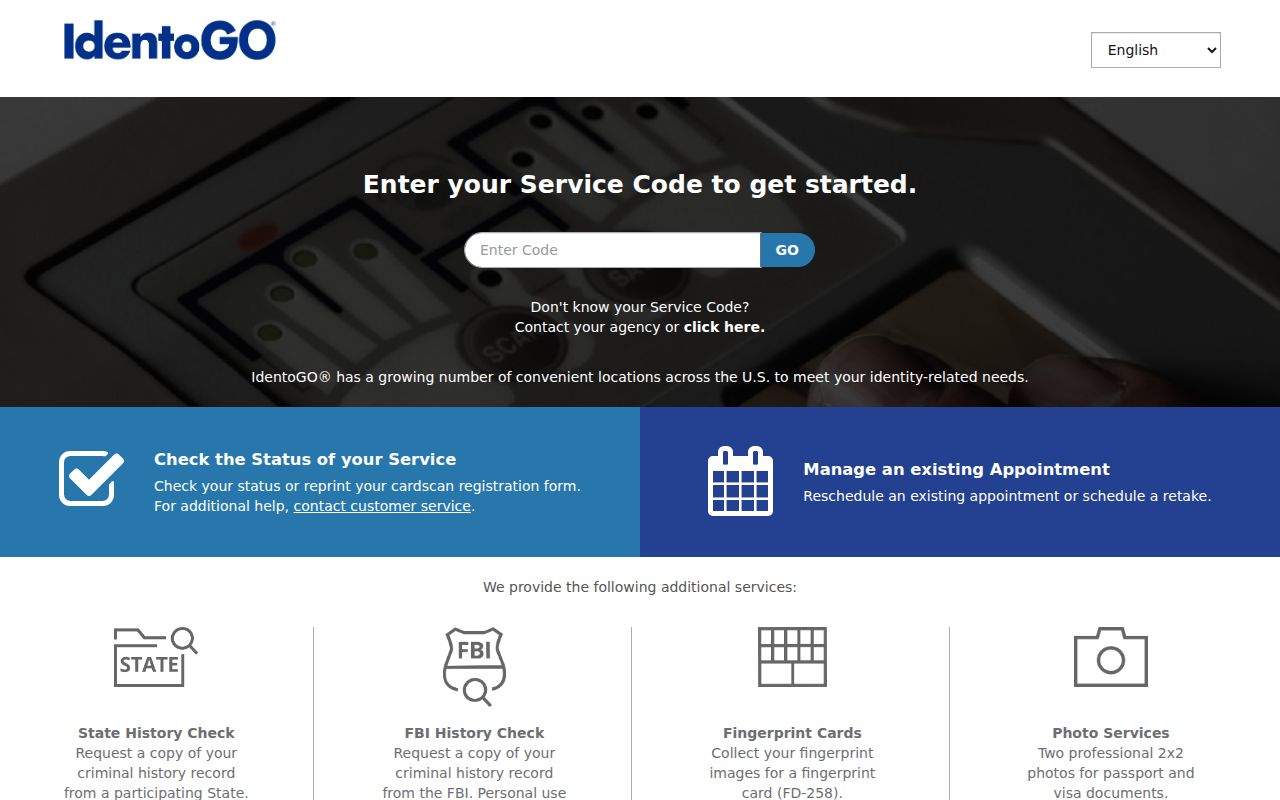
Because vendor sites and hours can change, search by Refugio ZIP 78377 instead of relying on a copied address.
DPS says a personal-review response may take about ten business days after receipt. That timing does not govern Refugio County clerk copies, sheriff reports, or an FBI request. Each channel has its own scope and workflow.
Refugio County Criminal Records by City
The county's three largest incorporated places are Refugio, Woodsboro, and Bayside based on the 2020 Census. A city police agency may create the report, while Refugio County Jail logs custody and a county or district clerk records a higher-level filed charge. Municipal courts keep fine-only and ordinance matters within their jurisdiction. These city routes identify the correct first office without treating one local contact as the whole criminal history.
Refugio Criminal Records
Population 2,712 · County-seat records route through the courthouse, sheriff, jail, and creating police agency.
Woodsboro Criminal Records
Population 1,318 · Police reports begin with the town, while Municipal Court handles its own fine-only cases.
Bayside Criminal Records
Population 325 · Municipal Court provides a direct phone-and-counter route when no online lookup exists.
Refugio Warrants and Custody Levels
Refugio County has no public county warrant database. For a suspected felony or county warrant, call the sheriff at 361-526-2352 and confirm the answer with the issuing clerk. A municipal citation warrant belongs with the municipal court, while a JP matter belongs with the relevant justice court. TCIC and TLETS carry wanted-person information for law enforcement, but the public cannot run a self-search there. A docket may show a capias or warrant event, and a focused Chapter 552 request may obtain releasable facts.
Custody searches also split by government level. Refugio County Jail and VINELink address local custody. The TDCJ Online Inmate Search covers state prison records and can search by TDCJ number, SID, or name with refiners. The Bureau of Prisons locator covers federal custody. None is a substitute for the others, and none alone proves the final outcome of a Refugio County charge.
Take care before acting on a possible warrant. Status can change, and similar names exist. Confirm the issuing court and address counsel and bond logistics before going to a place where an arrest may occur.